Introduction
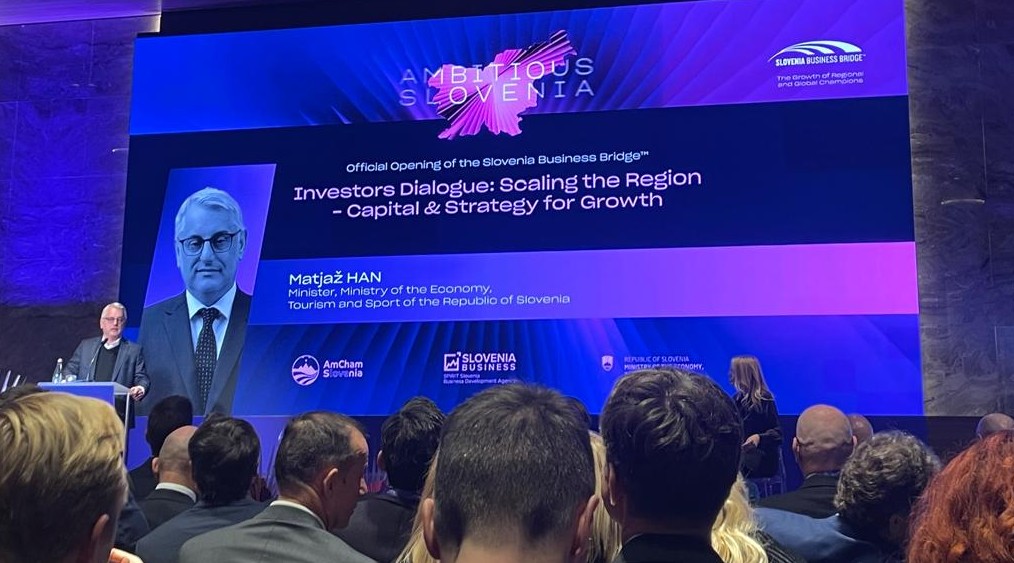
On April 17, 2026, the AmCham Slovenia Business Breakfast brought together leading voices from healthcare, pharmaceuticals, digital innovation, and patient organizations to address one of the most complex challenges facing modern economies: the future of healthcare systems.
FinFrac’s leadership was present at the event, continuing our commitment to staying closely aligned with key policy, economic, and industry developments shaping the business environment.
While the discussion focused on healthcare, the implications extend far beyond the sector itself. At its core, the future of healthcare is also a financial question.
Key Insights from Industry Leaders
The discussion brought together senior representatives from healthcare institutions, the pharmaceutical industry, digital health providers, and patient organizations, offering a well-rounded perspective on the future of healthcare systems.
Contributions from speakers including Tomaž Gornik (Better), Robert Ljoljo (ZZZS), Nika Marđetko (Novartis), Matej Pečovnik (OnkoMan), and Marko Pokorn (UMC Ljubljana) highlighted a shared understanding: healthcare is no longer a sector that can be viewed in isolation — it is a fundamental pillar of economic and societal development.
Several key themes emerged from the discussion.
A central point was the recognition that access to healthcare extends beyond individual wellbeing and directly influences broader economic performance and social stability. In this context, a healthy population is not only a social objective, but also a driver of productivity and long-term growth.
Speakers also emphasized the need for a shift in perception — from treating healthcare as a cost center toward recognizing it as a long-term strategic investment. This reframing has significant implications for both public policy and financial planning, requiring more structured and forward-looking funding models.
Another important focus was the role of data in shaping modern healthcare systems. The ability to leverage data effectively enables:
• more precise diagnostics
• development of personalized treatment pathways
• evaluation of healthcare technologies based on measurable outcomes
This marks a transition toward outcome-based systems, where decisions are increasingly guided by real-world impact rather than assumptions.
At the same time, it was highlighted that the true value of data lies not only in its availability, but in its integration into decision-making processes — both operational and financial.
Taken together, these perspectives reinforce a broader conclusion:
the future of healthcare will depend on the ability to align data, innovation, and financial structures into a cohesive and sustainable system.
Healthcare as an Economic System
Healthcare is no longer viewed solely as a public service. It is increasingly understood as a complex economic ecosystem requiring:
• sustainable funding models
• efficient resource allocation
• data-driven decision-making
• long-term financial planning
The discussion clearly emphasized that without financial discipline and strategic structuring, even the most advanced healthcare systems face operational and systemic risks.
For financial advisors and businesses, this reinforces the importance of understanding healthcare not only as a social priority, but as a major component of economic stability.
The Role of Data in Financial Efficiency
A key theme of the event was the importance of data — not just for medical outcomes, but for system-wide efficiency.
Better data management enables:
• more accurate forecasting of costs
• improved allocation of resources
• reduced inefficiencies in service delivery
• increased transparency and accountability
From a financial perspective, this represents a shift toward evidence-based budgeting and performance-driven investment decisions.
Organizations operating in or alongside healthcare systems must increasingly align with data-driven frameworks to remain competitive and compliant.
Innovation and Investment Dynamics
Innovation was highlighted as a critical driver of future healthcare systems, particularly in:
• digital health solutions
• AI-driven diagnostics
• pharmaceutical development
• patient-centered technologies
However, innovation introduces a fundamental financial challenge: how to balance investment with sustainability.
For both public institutions and private sector participants, this requires:
• structured investment planning
• risk assessment frameworks
• long-term capital allocation strategies
At FinFrac, we see similar dynamics across industries — where innovation must be supported by disciplined financial structuring to deliver sustainable outcomes.
Collaboration as a Financial Multiplier
Another central point was the importance of collaboration between:
• public institutions
• private sector companies
• healthcare providers
• technology partners
Collaboration is not only an operational necessity — it is also a financial multiplier.
Well-structured partnerships can:
• reduce duplication of costs
• improve efficiency
• accelerate innovation
• enhance return on investment
For businesses, this highlights the importance of structuring partnerships with clear financial frameworks and aligned incentives.
Sustainability and Cost Pressures
Healthcare systems across Europe are facing increasing cost pressures driven by:
• aging populations
• technological advancement
• rising expectations for quality of care
The discussion made it clear that sustainability will depend on:
• better financial governance
• improved cost control mechanisms
• long-term planning beyond political cycles
This aligns closely with broader economic trends, where resilience is built through forward-looking financial strategies rather than short-term adjustments.
What This Means for the Financial Sector
For financial advisory firms and businesses, the implications are clear.
The evolution of healthcare systems reinforces several broader trends:
• the growing importance of data in financial decision-making
• the need for structured investment strategies
• increasing interconnection between policy and financial outcomes
• rising demand for long-term planning and risk management
Even for companies outside the healthcare sector, these developments influence:
• tax policy
• labor markets
• insurance frameworks
• overall economic stability
FinFrac Perspective: Strategic Alignment with Systemic Change
At FinFrac, we view events like the AmCham Business Breakfast as an essential source of insight into systemic change.
Our participation reflects a broader commitment to:
• staying ahead of regulatory and economic developments
• understanding cross-sector dynamics
• translating macro-level trends into practical financial strategies
We support our clients in navigating increasingly complex environments by aligning financial structures with long-term economic and policy direction.
Conclusion
The future of healthcare is not only a matter of policy or technology. It is fundamentally a question of financial sustainability, strategic investment, and system-wide efficiency.
The discussions at AmCham Slovenia reaffirm that the most successful systems — and businesses — will be those that integrate data, innovation, and financial discipline into a coherent strategy.
For companies operating in today’s environment, the ability to connect these elements is no longer optional. It is a defining factor of long-term success.