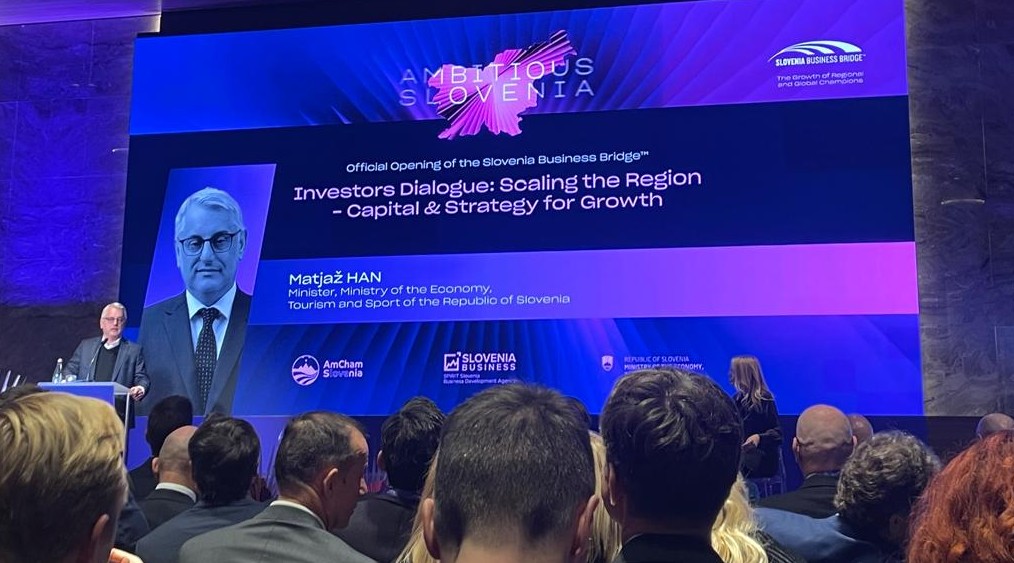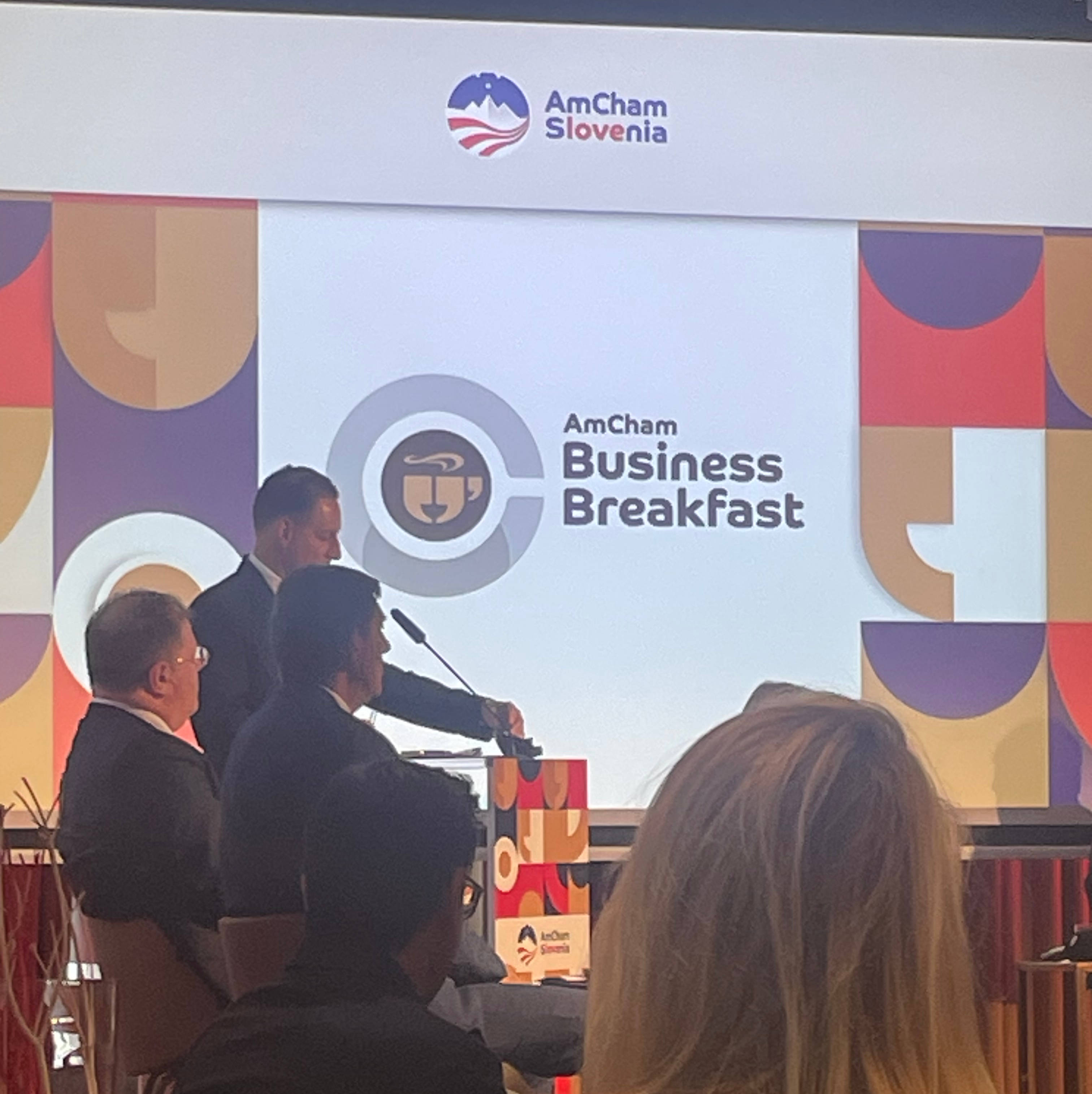
At the first AmCham Slovenia Business Breakfast of the year, held in the symbolic context of the 250th anniversary of the United States, AmCham Slovenia opened an important strategic discussion on the future of transatlantic relations. The event, titled “USA 250: Influence, Dominance or Partnership?”, brought together representatives of business, diplomacy and policy to reflect on how Europe and the United States can maintain a stable, balanced and predictable partnership in an increasingly complex global environment.
FinFrac was pleased to be present at this discussion, as the themes addressed align closely with our work in financial consulting: navigating uncertainty, structuring long-term decisions and supporting cross-border growth.
A key conclusion shared across the panel was that the United States should not be reduced to current politics or individual political figures. The transatlantic relationship is shaped by people, companies and long-term cooperation, built over decades through trade, investment, innovation and shared values.
In his opening remarks, Beno Ceglar, President of AmCham Slovenia, highlighted the importance of optimism and partnership in challenging times. He also emphasised a principle that resonates strongly with financial decision-making:
Value is easy to destroy, but extremely difficult to build — or rebuild.
This statement reflects a reality familiar to businesses and investors alike: trust and stability are not abstract ideals, but key drivers of sustainable economic performance.
Throughout the discussion, it was repeatedly underlined that business on both sides of the Atlantic requires clear frameworks, reliable information and continuous dialogue. In times of growing global uncertainty, sudden changes in policy, trade measures or regulation can quickly affect markets, investment plans and long-term strategy.
The panel addressed the broader consequences of rising tensions and announced trade-related measures, which can impact not only the directly affected markets but also entire supply chains — including companies in countries closely connected to those markets.
A particular focus was placed on the fact that transatlantic cooperation is not only about politics, but also about jobs, competitiveness and long-term economic resilience.
Barbara Žibret Kralj, Executive Director and Partner at Deloitte Slovenia, highlighted that the impact of political developments on the economy is already measurable. According to her remarks, indicators of economic growth are declining, and cooperation between the United States and some key European economies has decreased significantly over the past year — with direct consequences for Slovenian companies as well.
The discussion further emphasised that uncertainty affects not only strategic decisions but also operational planning, capital allocation and confidence in long-term commitments.
Professor Boštjan Udovič pointed to a trend that is becoming increasingly visible in international relations: after decades, we are again facing a period in which political developments are moving ahead of economic logic. This shift increases unpredictability and creates additional challenges for businesses that rely on stable and foreseeable conditions.
For companies operating internationally, such unpredictability can translate into higher risk premiums, slower investment cycles and increased caution when entering new markets.
Participants emphasised that transatlantic economic relations remain among the most important in the world, supported by deep trade and investment ties. The transatlantic relationship continues to represent the strongest economic partnership globally — not only through trade volumes, but through mutual investment, innovation exchange and long-standing business connections.
Ajša Vodnik, General Director of AmCham Slovenia and President of AmChams in Europe, highlighted that businesses do not seek dominance in economic relations, but rather:
She also underlined that economic debates often focus too narrowly on trade, while investments play an equally critical role in shaping long-term stability and shared prosperity.
Dr. Miro Cerar, Professor and Dean at the Faculty of Law, University of Ljubljana, addressed the role of Europe in a changing global order. He emphasised that the European Union must maintain its democratic identity, commitment to the rule of law and shared values — while also recognising its strength and influence.
The discussion reinforced that competitiveness is not only economic, but also institutional: stability, credibility and legal predictability remain among Europe’s most important strategic advantages.
For FinFrac, these themes are not theoretical. Transatlantic dynamics directly influence the environment in which businesses operate and make decisions, including:
As a financial consulting company, FinFrac supports clients in translating uncertainty into structured decisions — through financial modelling, strategic planning and execution support. In a world where volatility can quickly reshape markets, the ability to act with clarity and discipline becomes a competitive advantage.
The Business Breakfast reinforced a core insight: transatlantic cooperation is not sustained by institutions alone. It is built through daily connections between people, companies and communities — through business cooperation, innovation, research, entrepreneurship and shared long-term commitments.
FinFrac thanks AmCham Slovenia for creating a platform where these conversations can take place openly, responsibly and strategically. We value the opportunity to engage with leaders and experts who understand that trust, predictability and partnership are not optional — they are essential foundations for sustainable economic growth.